01incidents
An incident with evidence, not a stream of events
A burst of failed logins, a login after brute force, a new access key, a new listening port. Every incident carries a “why” line and evidence with time and source.
observe · evidence · incidents
ArgusSOC reads server logs and syslog from network equipment, gathers evidence into incidents and explains why each one is an incident. It changes nothing on your systems.
$ argus tail --org demo
21:30:14 mail1 info auth_failed_burst sshd x41 / 20 min
21:32:02 mail1 crit auth_ok_after_fail login after 41 failures
21:32:40 mail1 crit access_key_changed new key added
22:05:11 border-r1 high netdev_config_changed outside maintenance window
22:41:37 billing crit new_listener unknown process, public port
23:02:09 win-dc1 warn rdp_password_external external address
21:36:00 incident #41 critical · intrusion · mail1 · evidence 3
$
$ argus --how
Data flows one way: from your systems to the center.
A small program on a server or workstation. It reads login logs and the protection state: firewall, packages, listening ports, accounts.
Sits inside your network. Receives agent data and syslog from equipment, keeps a queue on disk when the link is down, and sends everything over a single channel.
Groups events into incidents with evidence, evaluates them with rules that have open thresholds, and sends notifications.
A web panel for your team: incidents, servers, equipment, vulnerabilities and backups. Works on a phone too.
$ argus --features
Everything you need to know about the security of a node, in one place.
01incidents
A burst of failed logins, a login after brute force, a new access key, a new listening port. Every incident carries a “why” line and evidence with time and source.
02equipment
The hub receives syslog and parses it by device type. A login from an unknown address, password guessing or a configuration change outside the maintenance window becomes a suspicion.
03posture
A firewall that allows everything, a database without a password on the network, Windows auditing switched off. A finding closes itself once the problem is fixed.
04vulnerabilities
The center refreshes vulnerability databases once a day and checks every server's packages against them. Vulnerabilities already exploited in the wild are marked separately.
05load
Charts from one hour to one year with incident markers on the same timeline. You can see what the server was doing at the moment of the event.
06backups
On schedule the agent runs your script, encrypts the file and uploads it to storage. Backups made by other programs are visible too: whether they ran and how they ended.
07workstations
The agent runs on Windows and macOS. On Windows you see whether updates are installed, whether built-in protection is running and which USB drives were connected.
08alerts
New incidents arrive in your team's messenger. You also learn when a source goes silent.
09ai analysis
A model reads the incident's evidence and explains what happened and what to check. Its verdict is not evidence: an incident is opened by a rule, not by the model.
10teams
Several organizations, branches or customers in one installation. Roles from viewer to owner, sign-in by invitation only, every action written to the audit log.
$ argus --panel
Organization overview: open incidents, server and hub status, coverage gaps.
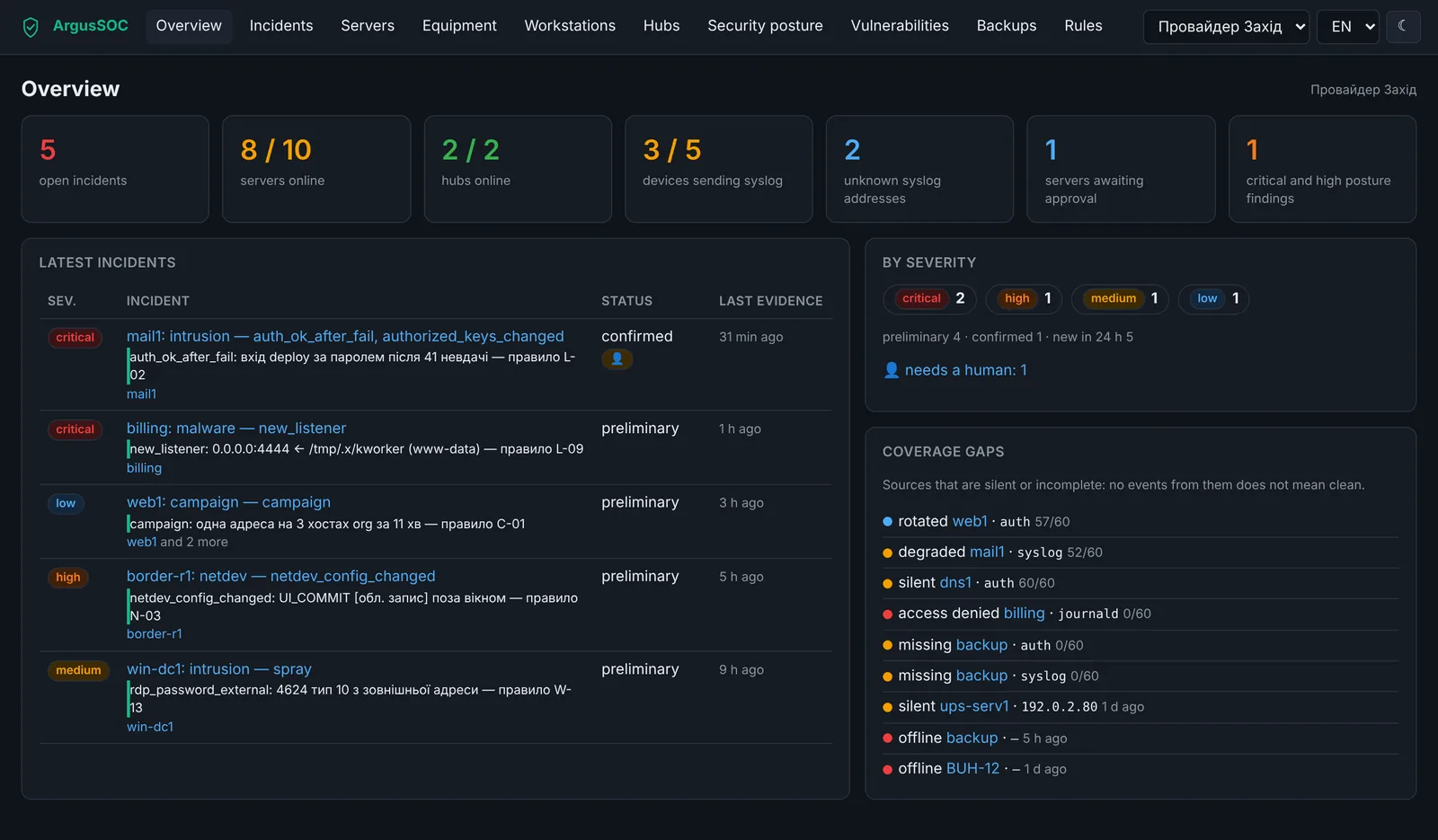
Panel screenshot with demo data.
$ argus --principles
A security service must not become a risk itself.
The agent and the hub change nothing on servers or equipment. They have no remote commands.
Updates and settings from the center are accepted only with a signature.
If a source is silent or delivers incomplete data, the panel shows it. No events does not mean “clean”.
Every rule has an open threshold and false-positive statistics.
An operator confirms an incident or marks a false positive. That decision is logged and feeds back into rule quality.
The addresses of your servers and users are visible only to members of your organization.
$ argus request-access
There is no sign-up: access is by invitation. Leave a request and we will get back to you.
Form data goes only to the ArgusSOC team. The site stores a single cookie: your chosen language.